Skip to main content
5 key benefits of an ISA

Individual Savings Accounts (ISAs) remain popular because they let you save or invest without paying tax on the returns you make inside the account. That can mean no tax on interest from cash savings, dividend income from investments, and no Capital Gains Tax if your investments rise in value. You also have a degree of choice over how the money is held, which makes ISAs useful for anything from short-term savings to longer-term investment planning.
Arrange your free initial consultation
What is an ISA?
Commonly referred to as an ISA, an Individual Savings Account allows you to hold savings and investments without paying tax on income or capital gains. There are four types of ISA available:
- Cash ISA
- Stocks & Shares ISA
- Innovative Finance ISA (IFISA)
- Lifetime ISAs (LISAs)
The ISA allowance, which is the most an individual can save into an ISA each tax year, is currently £20,000. You can split your allowance across the different types of ISAs, for example saving £10,000 into a Stocks & Shares ISA and £10,000 into a cash ISA. This can include up to £4,000 into a Lifetime ISA, provided you are eligible.
From 6 April 2027, the annual Cash ISA limit for people under 65 will fall to £12,000, although the overall £20,000 ISA allowance will remain unchanged. Those aged 65 and over will still be able to save the full £20,000 into a Cash ISA.
For most ISAs, you can pay into more than one ISA of the same type in the same tax year, as long as you stay within the overall annual allowance. Lifetime ISAs and Junior ISAs are treated differently, so it is important to check the rules before making contributions.
A Junior ISA (JISA) can also be opened for children under the age of 18 and can be either cash or investment based. The savings limit for Junior ISAs is currently £9,000 per child per tax year, and this is in addition to the adult ISA allowance. So even if you are saving cash into the JISA for your child, as that money is now theirs, anything you pay in for them does not reduce your own personal ISA allowance.
Around £103 billion was subscribed into adult ISAs in the 2023/24 tax year across approximately 15 million accounts, an increase of £31.4 billion compared with 2022/23. Up to the end of the 2020/21 tax year there was an increasing trend towards the use of Stocks & Shares ISAs in the search for greater financial returns, with interest rates at rock bottom levels. This trend has since shifted back towards Cash ISAs. Cash ISA subscriptions rose by 67%, or £27.9 billion, in 2023/24 as higher interest rates made tax-free cash savings more attractive. Although Bank Rate has since fallen from its 5.25% peak to 3.75%, Cash ISAs continue to offer a valuable way to shelter savings interest from tax.
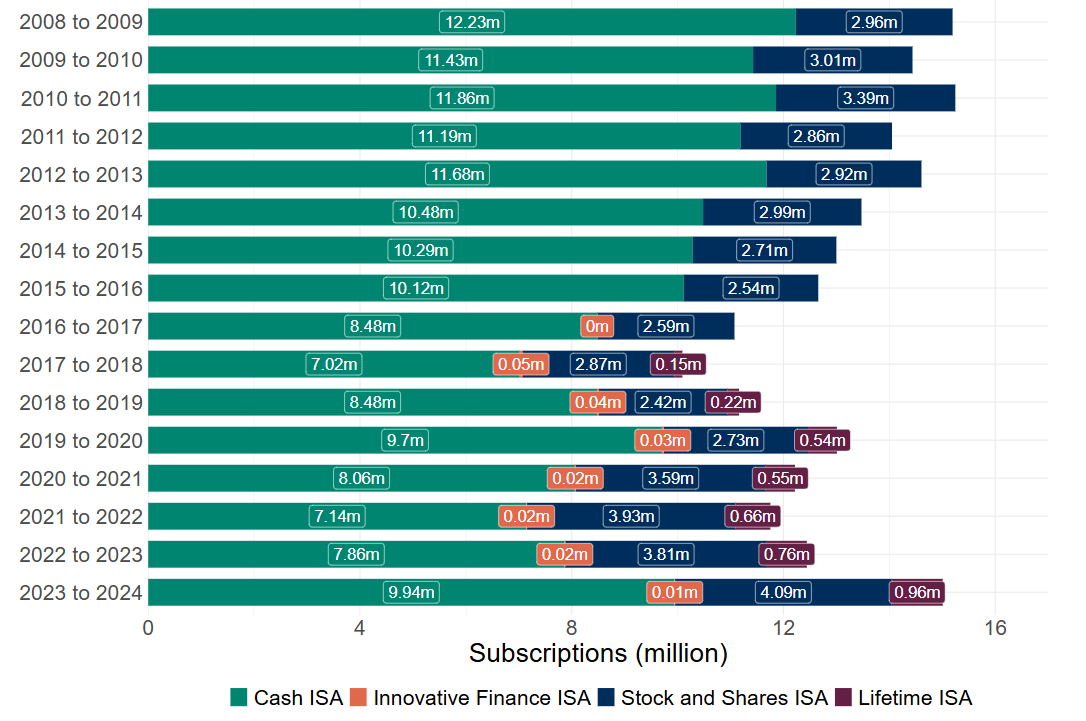
Figure 1: Number of Adult ISA accounts subscribed to per tax year, (Source: Gov.uk, 2025)
5 main benefits of an ISA
1. Protecting your annual Personal Savings Allowance
With the exception of additional rate taxpayers, most people have a Personal Savings Allowance (PSA) which means basic rate and higher rate taxpayers can receive tax-free interest of £1,000 and £500 per tax year, respectively. Above these tax-free thresholds, and on all interest received by additional rate taxpayers, interest received outside of an ISA is subject to an individual’s marginal rate of income tax. Whereas, within an ISA, any interest received is sheltered from income tax. With interest rates payable on savings accounts increasing, the likelihood of interest received on savings outside a Cash ISA breaching your personal savings allowance increases too, so any money outside of the ISA accounts allowance would be subject to income tax, making Cash ISAs a more useful tool in tax mitigation for cash-based savings, particularly for higher rate taxpayers and especially for additional rate taxpayers who have never had a personal savings allowance.
2. Capital Gains Tax: making the most of your annual allowance
The Capital Gains Tax annual exempt amount remains at £3,000 for the 2026/27 tax year. This is considerably lower than the £12,300 allowance available in 2022/23, meaning more people may now face tax when selling investments, property or other chargeable assets.
Since 30 October 2024, the main Capital Gains Tax rates have been 18% for gains falling within the basic rate band and 24% for gains above it. These rates already applied to residential property, so the change did not increase the tax rate on gains from buy-to-let properties. However, the smaller annual allowance means a greater proportion of any gain may now be taxable.
Investments held within a Stocks and Shares ISA remain sheltered from Capital Gains Tax. This can make effective use of ISA allowances increasingly valuable when building a long-term investment portfolio.
3. Dividend Allowance remains at £500 as tax rates rise
The Dividend Allowance remains at £500 for the 2026/27 tax year. This is considerably lower than the £2,000 allowance available in 2022/23, meaning investors holding dividend-paying assets outside a tax-efficient wrapper may now have more tax to pay.
Dividend tax rates also increased from 6 April 2026. Dividends above the allowance are now taxed at 10.75% within the basic rate band and 35.75% within the higher rate band. The additional rate remains unchanged at 39.35%.
Dividends received from investments held within a Stocks and Shares ISA remain free from tax and do not use any of the £500 Dividend Allowance.
4. Tax Free withdrawals from your ISAs
Alongside sheltering any income or capital gains from tax, you can withdraw funds from both Cash and Stocks & Shares ISAs tax free and typically without incurring a penalty, although penalties or restrictions may apply to some fixed-rate Cash ISAs.
5. Easing the administration burden
Lastly, not only can ISAs help to reduce your tax burden, but they can also help to ease the administrative burden of completing a tax return or in some cases negate the need to complete a tax return altogether.
Points to consider
Unlike the amount you are able to contribute into a pension each year (the Annual Allowance), you are not able to ‘carry forward’ any unused ISA allowance from previous tax years. Therefore, if part or all of an ISA allowance for a tax year isn’t used by the 5th April deadline, it’s lost. ‘Use it or lose it’.
Furthermore, as the name would suggest, an ISA is an individual account, hence it cannot be transferred or shared during your lifetime, and likewise any unused allowance cannot be passed to a spouse or partner.
The amount that has been saved into an ISA can be transferred to a spouse or civil partner after your death, with the surviving partner retaining the tax-efficient status of an ISA (the surviving partner will inherit a one-off additional ISA allowance known as the ‘Additional Permitted Subscription’). ISAs do form part of your estate for Inheritance Tax purposes and are potentially subject to Inheritance Tax on death.
It is important to consider that for cash-based savings, the interest rates offered by ordinary savings accounts can sometimes beat the returns offered by Cash ISAs, even after accounting for the potential tax liability payable. Therefore, Cash ISAs might not always be the best option for savings.
Can I lose money in an ISA?
The level of risk in an ISA largely depends on the type of ISA and the investments you choose. Cash ISAs are typically considered safe, as your initial deposit is secure, but the returns may be lower and subject to inflation. Stocks and Shares ISAs, on the other hand, carry the potential for higher returns but also come with the risk of losing money if the market performs poorly. Innovative Finance ISAs can offer higher interest rates but also involve risks like borrower defaults. Understanding these differences can help you choose an ISA that aligns with your financial goals and risk tolerance.
How we can help
If you would like to learn more about how you can make use of your ISA allowance to build wealth tax efficiently, or if you would value a review of any existing ISA arrangements, why not get in touch with us and arrange an initial free consultation today with one of our expert advisers.
Arrange your free initial consultation
The information contained within this article is for guidance only and does not constitute advice which should be sought before taking any action or inaction.
The information is based upon our understanding of legislation, whether proposed or in force, and market practice at the time of writing. Levels, bases and reliefs from taxation may be subject to change.
The value of investments can go down as well as up, you may not get back what you originally invested. The FCA does not regulate tax, estate or cash flow planning.